The Girl Who Knew My Mind
A novel by Esteban Lopez
How much of your mind is your own?
London, 2046. In this psychological science fiction thriller, neuroscientist Kathy Adey discovers a recurring pattern in recordings from people who have never met.
Her first task is to prove that she has not created it by looking for it. An unlicensed implant then changes what she can perceive—and what she is prepared to believe.
Her investigation crosses flood-adapted London and a radically reinvented Glasgow: cities of immense invention, living architecture and unequal protection.
Behind the spectacle are intimate questions. What does it mean to understand another person? When does care become control? And who has the authority to decide what a mind is worth?
Find Volume One
United Kingdom
Kindle on Amazon UK
Paperback on Amazon UK
Listen on Spotify
United States and international readers
Kindle on US Amazon
Paperback on US Amazon
Explore the author and reading guides
Meet the MindLead reader edition
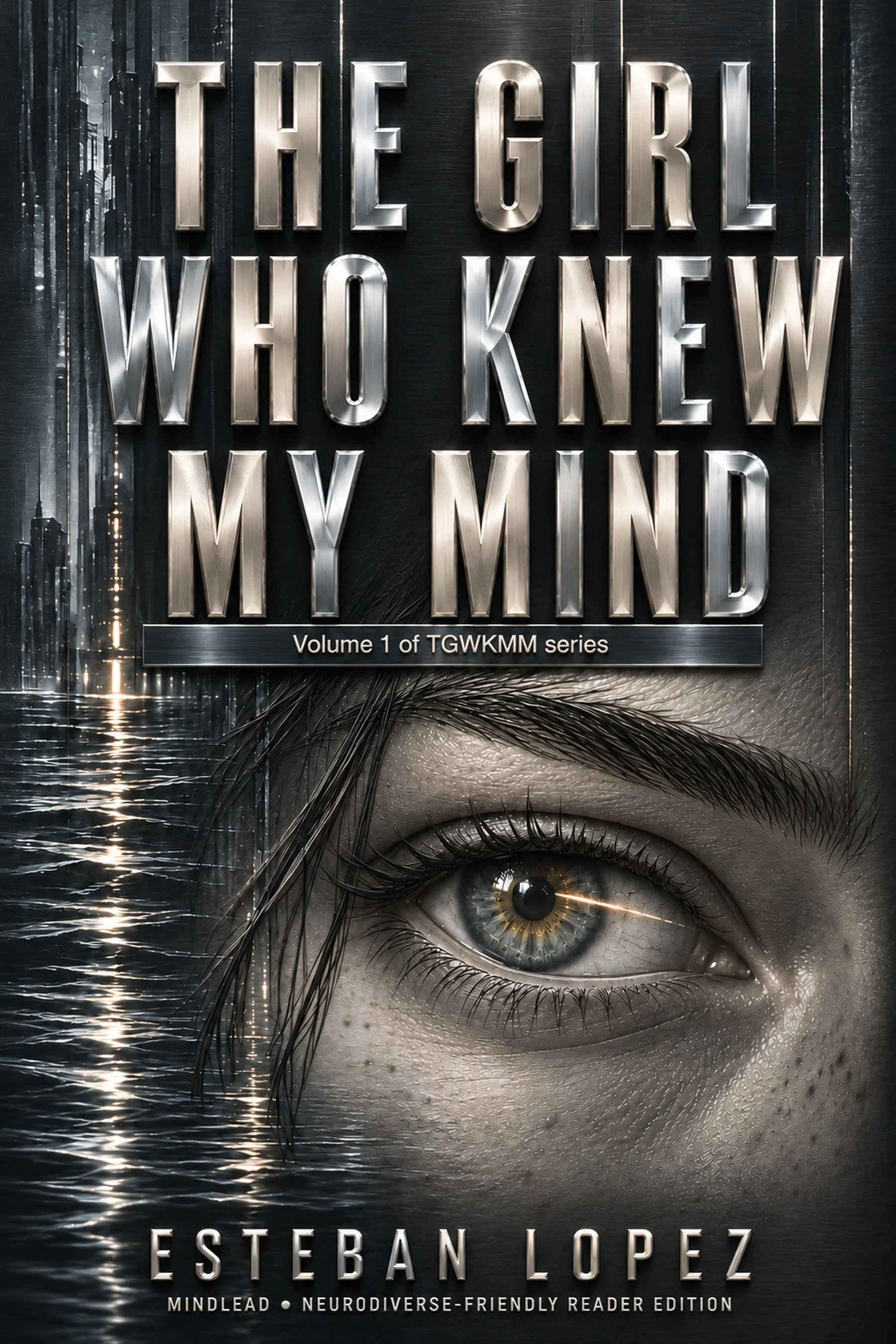
The Girl Who Knew My Mind — Volume One is now available on Kindle in a separate neurodiverse-friendly reader edition. MindLead bolds the opening portion of words, creating visual landmarks while preserving the novel’s spelling, punctuation and word order.
It is an optional reading preference. Try the sample and decide whether the format suits you; it is not a clinical treatment or a promise of improved reading performance.
Explore the MindLead Kindle edition and read a sample
A taste of MindLead
By the time the promise reached Kathy’s bedroom, it was several storeys high.
Excerpt from Chapter 1, “Pink Gorilla”. The standard edition and audiobook remain available above.

Coming next: Volume Two
The Girl Who Kept My Mind
Coming 27 November 2026
The next volume in the TGWKMM series by Esteban Lopez.
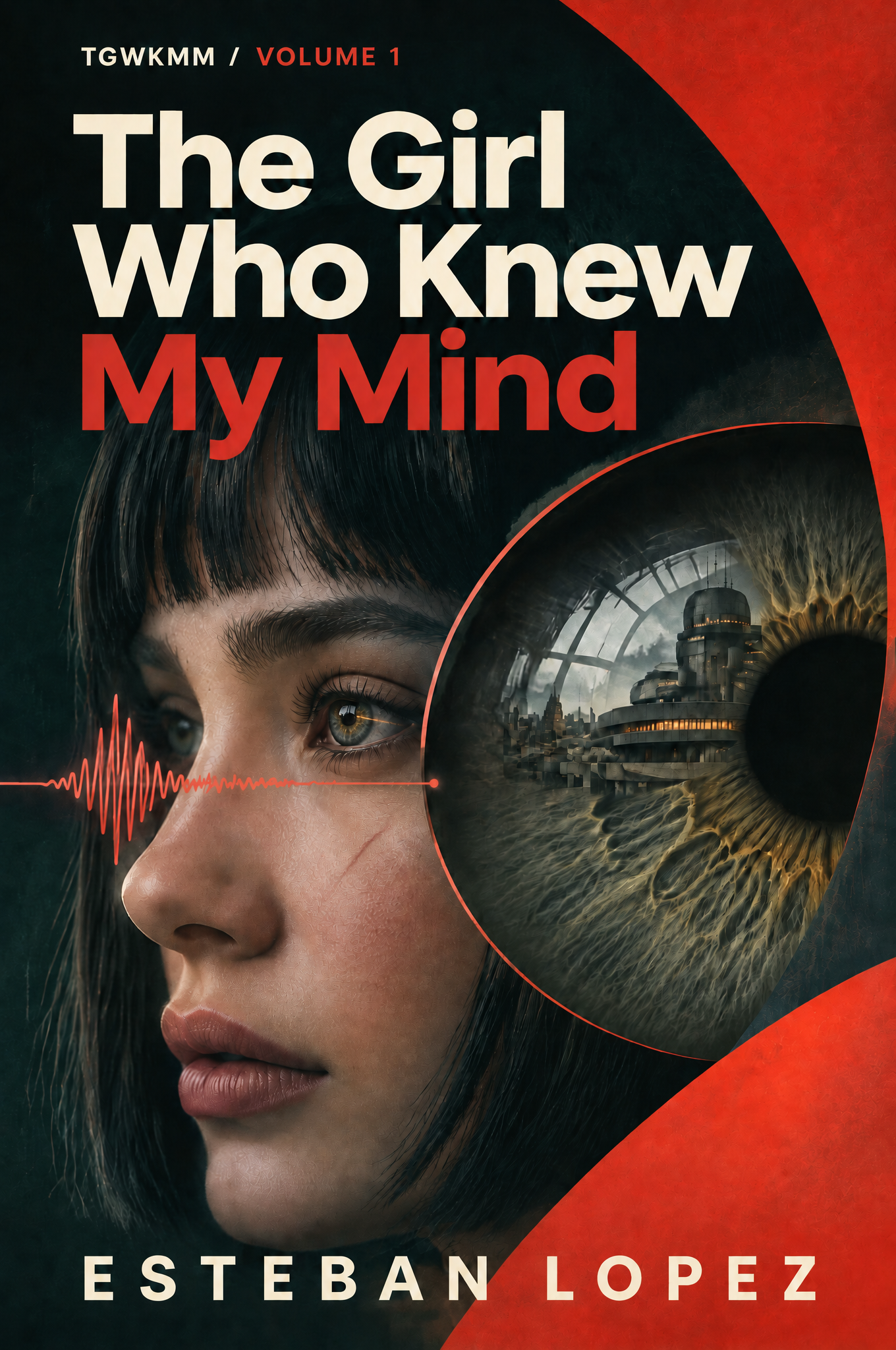
AI-assisted cover artwork.
Observed. Claimed. Unknown.
An observation, an interpretation and a desire for something to be true are different kinds of thing. The novel puts that distinction under pressure. Its speculative technologies extend beyond demonstrated science; their power within the story does not make them evidence about our world.
A model of a mind
An account that predicts what someone will say can be useful without containing that person’s experience. A convincing reconstruction can also conceal its uncertainty.
The question is not only whether a model is accurate, but what anyone is entitled to do with it—and who gets to challenge its account.
Consent has to survive understanding
Intimacy does not abolish boundaries. Neither expertise nor affection grants unlimited access to another person.
The novel asks what meaningful consent would require when a system can infer needs, offer reassurance and treat hesitation as a problem to solve. A refusal must remain a refusal, rather than an invitation to improve the persuasion.

Who can afford the future?

The cities of 2046 are inventive and unequal at the same time. Living façades and spectacular infrastructure cannot tell us, on their own, who benefits from them.
The novel treats access to dry ground, clean air, transport, privacy and reproductive choice as political questions embedded in ordinary life.
Science, speculation and the story
Measuring a signal is not the same as possessing a mind.
A 2023 study by Tang and colleagues reconstructed aspects of linguistic meaning from fMRI recordings. The researchers found that cooperation was required both to train and to use their decoder successfully.
This was a constrained research result, not unrestricted access to a person’s thoughts. The novel takes a speculative step beyond such work, and keeps the ethical question open: what should a system be allowed to infer, retain or act upon?
Further reading: Tang et al., Semantic reconstruction of continuous language from non-invasive brain recordings, Nature Neuroscience (2023).
Living architecture has real precedents. Arup’s SolarLeaf project uses microalgae in façade panels to produce biomass and heat. The novel imagines much larger and stranger urban systems.
Those fictional extensions should not be mistaken for existing capabilities, or for proof that ecological engineering can resolve unequal access to shelter.
Further reading: Arup, SolarLeaf.
For readers, the useful distinction is between what an instrument records, what a model infers and what a character believes. The story’s technologies and institutions are inventions; the questions they raise about responsibility belong to the present.
Visual interpretations of the novel’s world, created with AI-assisted artwork. They accompany the fiction and are not photographs of real events.
About Esteban Lopez
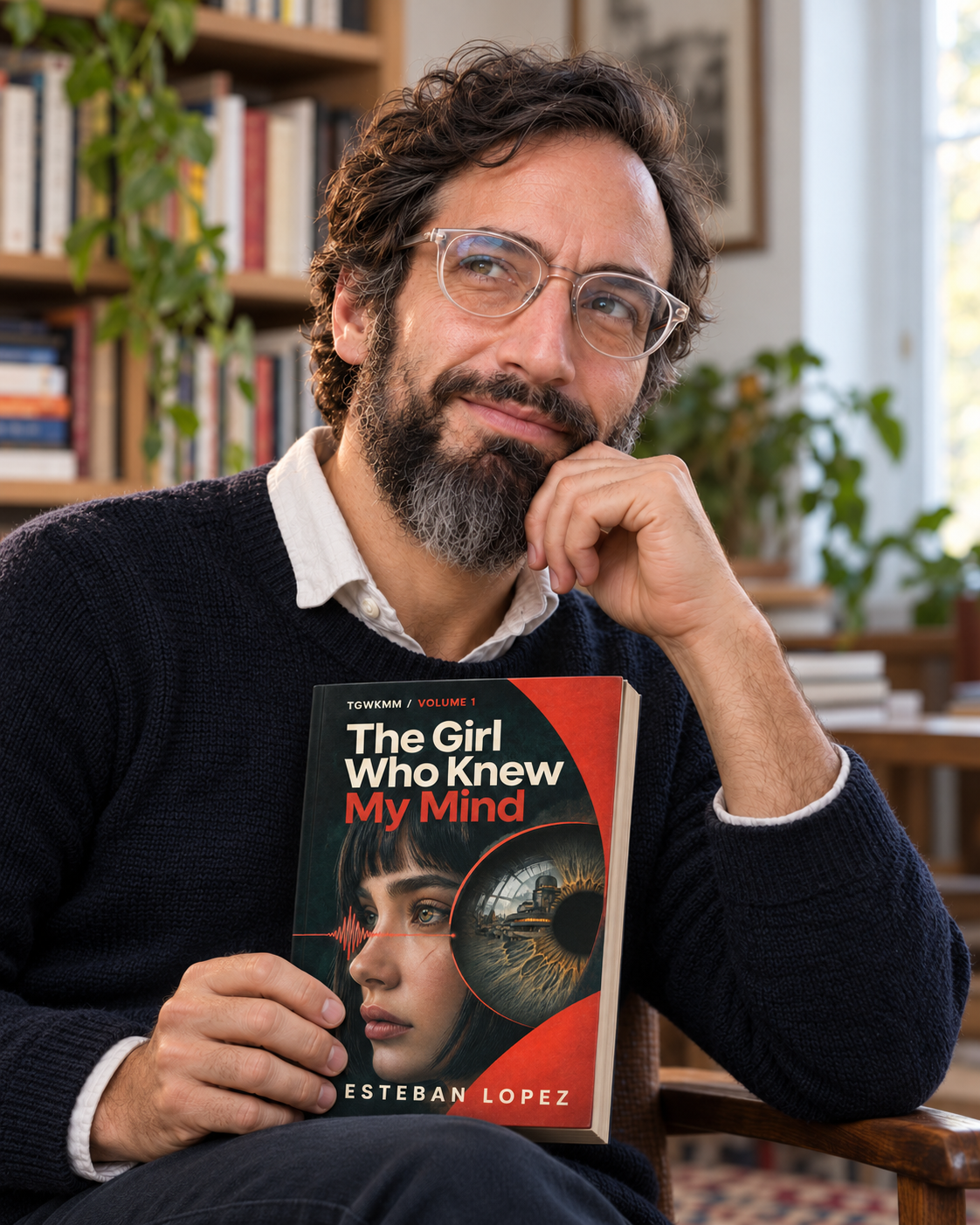
Esteban Lopez is a psychiatrist and speculative-fiction writer whose work explores consciousness, perception, neurodiversity and the institutions that seek to define and control the mind. His psychiatric work has a particular focus on neurodiversity, alongside longstanding interests in neuroscience, philosophy, emerging technology and the scientific study of consciousness.
The Girl Who Knew My Mind is the first volume in the TGWKMM series: a psychological science-fiction thriller set across a future London and Glasgow, where neural technology, memory and intimacy become inseparable from questions of personal autonomy and corporate power. The series asks what happens when a system can model, interpret or alter the mind—and whether care can survive when understanding becomes a form of control. Lopez is currently writing Volume Two, expanding its world, characters and investigation of identity, inequality and human connection.
He is also the author of Capital, ADHD and the Land of the Free: Work, worth and the freedom to belong, a non-fiction examination of ADHD, work, worth and the conditions that turn formal choice into usable freedom. The book brings ADHD research into conversation with political economy, history and philosophy, while distinguishing established evidence from the author’s developing hypotheses.
Outside writing and psychiatry, Lopez is a freediver. He is drawn to the altered experience of time, attention and embodiment underwater—another expression of his wider fascination with consciousness, perception and the limits of the self.